

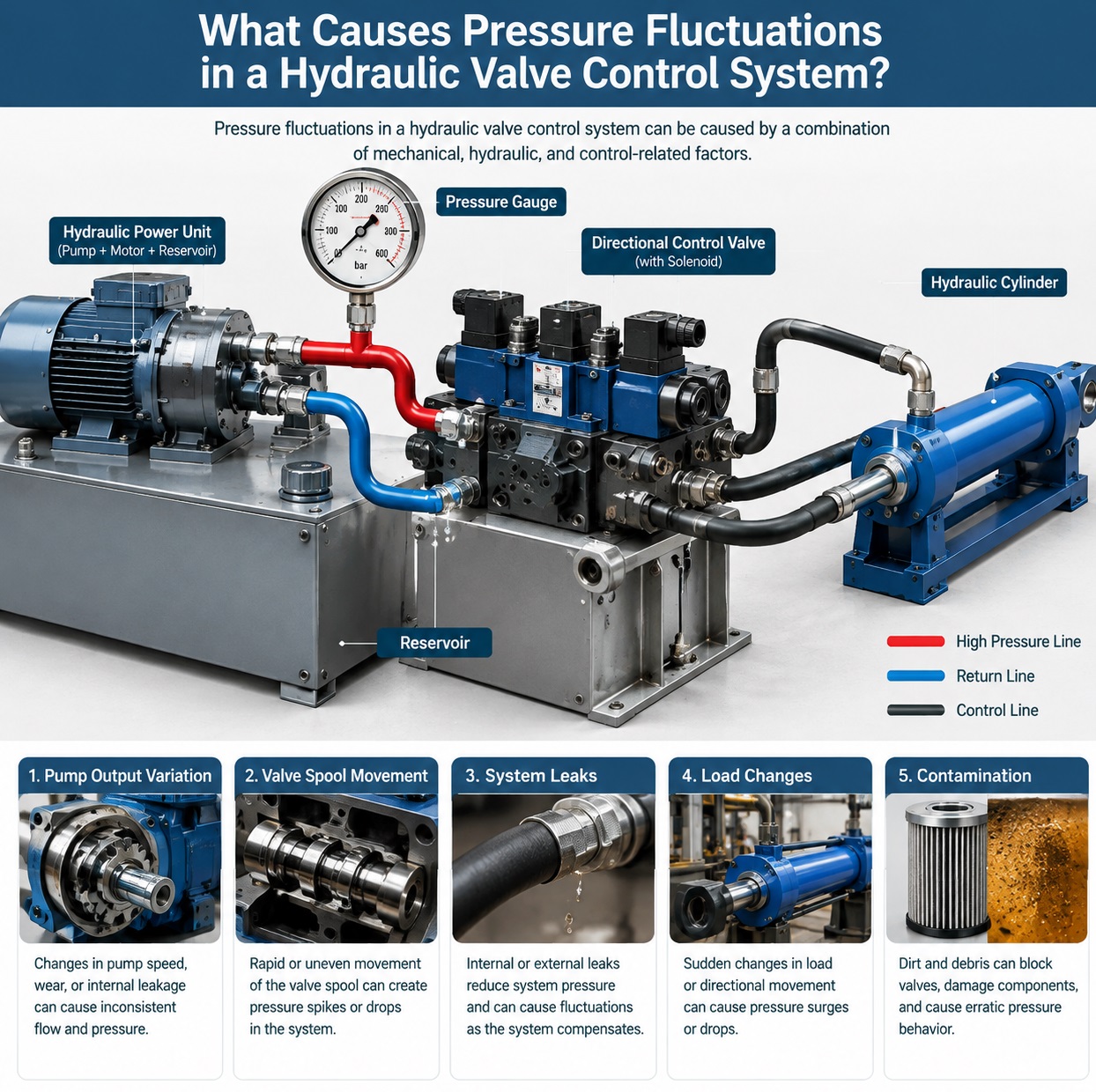
 A pressure gauge that twitches like a nervous eye is not a personality quirk of your hydraulic system. It is a message. Sometimes it is shouting about air in the oil. Sometimes it is whispering about a worn valve spool. Either way, pressure fluctuations in a hydraulic valve control system rarely come from one lonely culprit. They come from a chain of small compromises, and the valve is often the messenger, not the crime.
I have watched a shop spend three weeks replacing pumps, hoses, and even a perfectly good proportional valve because nobody checked the return line backpressure. The pressure trace still looked like a seismograph. That is the trap. You replace parts, the fluctuation shifts a little, and you convince yourself you are making progress. You are not. You are chasing symptoms.
Start with the supply side. A pump that pulses, cavitates, or struggles to draw oil will send that irregularity straight into the valve. A clogged inlet strainer, undersized suction line, or oil that is too thick on a cold morning can create cavitation. Air entrainment does the same thing. If the reservoir return dumps oil above the fluid level, or a fitting on the suction side is loose, the pump compresses foam instead of oil. Pressure never settles because the fluid itself is not solid. Temperature swings make this worse. As viscosity changes, internal leakage changes, and the valve that was stable at 120°F becomes twitchy at 160°F.
The valve itself is the next suspect, and it is usually where the blame lands first. Spool wear opens clearances that should be tight. Contamination scratches metering edges and sticks to solenoid armatures. Stiction makes the spool jump instead of glide, so pressure spikes when it finally moves. Deadband and hysteresis in proportional or servo valves create a lag between command and response. Flow forces push against the spool, especially at high flow rates, and if the valve is undersized or the wrong spool type for the circuit, those forces win. Pilot pressure fluctuations can also ripple through a two-stage valve, making the main stage behave like it has a mind of its own.
Then there is the system around the valve. An accumulator with the wrong precharge will absorb pressure one minute and release it the next. A relief valve that chatters because it is set too close to system pressure will sing a constant, irritating song. A return line that is too small or restricted creates backpressure that fights the valve. Long hoses add compliance, so pressure drops when the load moves and spikes when it stops. Resonance is another quiet killer. Every hydraulic circuit has natural frequencies. If a pump pulsation or control loop matches one of them, pressure oscillations grow instead of fading.
Do not ignore the electronic side. A noisy command signal, a drifting pressure sensor, or a feedback device with poor resolution can make a stable hydraulic system look unstable. PID tuning that is too aggressive turns normal load changes into overshoot and ringing. A slow scan time in the controller adds phase lag, which is rocket fuel for oscillation. You can have the best valve in the world and still get a ugly pressure trace if the controller is fighting itself.
So what actually fixes it? Not a single magic part. The fix is a system that can hold pressure when the load moves, the oil heats, and the valve shifts. That means proper filtration, correct oil viscosity, a pump with low pulsation, a valve with stable metering and low hysteresis, and a control loop tuned with real data. It means checking suction lines for air leaks, setting accumulators correctly, and sizing return lines for the flow they actually see. It means measuring pressure at the valve, not just at the gauge on the power unit.
This is where good valve design earns its keep. A valve with tight tolerances, robust spool geometry, and predictable flow characteristics gives you a foundation. Add clean oil, stable pilot pressure, and a controller that is not over-caffeinated, and pressure fluctuations drop from a problem to a footnote.
If your pressure trace looks like a bad heartbeat, stop guessing. Bring the data. Look at pump pulsation, valve wear, contamination, accumulator health, return line backpressure, and control tuning in the same conversation. The cause is almost never where the gauge is. It is upstream, downstream, or in the loop between them. Fix the system, not just the symptom, and your hydraulic valve control system will hold pressure like it was built to do exactly that.